Tuesday, 28 February 2012
Treatment 2
The films begins when Harry Jenkins is informed that the case of his missing sister has been closed due to lack of evidence. He is very upset to hear this news as he was hoping for the case to be solved, but he believes that he still will solve it, even without the help of the police. It seems that the news the police have brought him has made him even more determined to get to the bottom of it. He lifts his phone up to his face, still strongly gripping it, and begins dialing a number; but who's number? it's a mystery to the audience at this moment in time. He speaks about how he needs their help, that 'the feds' have 'fucked it' and the rest is up to them.
Treatment 1
The film begins with out company logo. It then cuts to a pan to reveal Harry and His girlfriend in bed. We see a close up of Harry restless in his sleep before cutting to a flashback of his missing sister in a dark room screaming. The scream then veers off and overlapped by a telephone ring which startles Harry from his slumber. Sitting up to answer the telephone he is greeted by an Officer Shades informing him the case on his missing sister is closed. Harry angrilly slams down the phone which wakes his girlfriend. She sits up to comfort him but they decide to leave so get dressed quicky and leave the house. Through a fade we see the couple arriving at a grave yard. They look at a stone on the ground and notice something stuck to it. Harry leans down to pick it up and unfold the piece of paper to reveal the words 'quit whilst you're ahead'which is the title of the film
Friday, 3 February 2012
Classic Psychological Thrillers; Gaslight (1944)
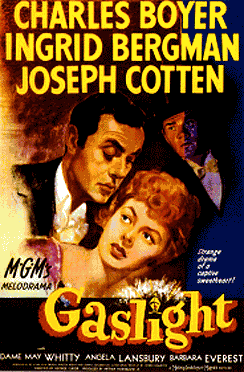
Director George Cukor's classic psychological thriller Gaslight (1944) (first made in Britain in 1939 with Anton Walbrook and Diana Wynward) is a superb, definitive psychological suspense thriller from 'woman's director' George Cukor. [Previous Cukor films that were similar as period dramas included Little Women (1933), David Copperfield (1935), and Camille (1936. The lavish and glossy MGM film, with authentic Victorian-era production design, was a remake of a taut and subtle film made four or five years earlier in Great Britain. This earlier version, starring a very sinister Anton Walbrook and Diana Wynyard, was directed by Thorold Dickinson and released in the US as both Gaslight and Angel Street (1940). When MGM decided to remake the film, it bought the rights to Dickinson's version and withdrew it from circulation (and reportedly - and unsuccessfully attempted to destroy prints of the film) - causing resentment among British film-makers.
The film was advertised as "the strange story of an international criminal's love for a great beauty," and "the strange drama of a captive sweetheart." The film's plot, faithfully adapted by its screenwriters, was about a diabolical, Victorian criminal husband (Charles Boyer playing against type) who systematically and methodically attempts to torment, menace, and drive his bedeviled, fragile wife (Ingrid Bergman) mad. Its title was derived from the frequent dimming and flickering of the gaslights. The phrase "to gaslight" someone (to deliberately drive someone insane by psychologically manipulating their environment and tricking someone into believing that they are insane),was derived from the film.
Early Thrillers;
One of the earliest 'thrillers' was Harold Lloyd's comic Safety Last (1923), with the all-American boy performing a daredevil stunt on the side of a skyscraper. The haunting and chilling German film M (1931) directed by the great Fritz Lang, starred Peter Lorre (in his first film role) as a criminal deviant - a child killer. The film's story was based on the life of serial killer Peter Kurten (known as the 'Vampire of Dusseldorf'). Edward Sutherland's crime/horror thriller Murders in the Zoo (1933) from Paramount starred Lionel Atwill as a murderous and jealous zoologist. And various horror films of the period, The Cat and the Canary (1927), director Rouben Mamoulian's Dr. Jekyll and Mr. Hyde (1931) with Fredric March, and The Bat Whispers (1930), provided some thrills.
Alien (1979)
Subscribe to:
Posts (Atom)
